Text-to-Image
Interior Design
通用
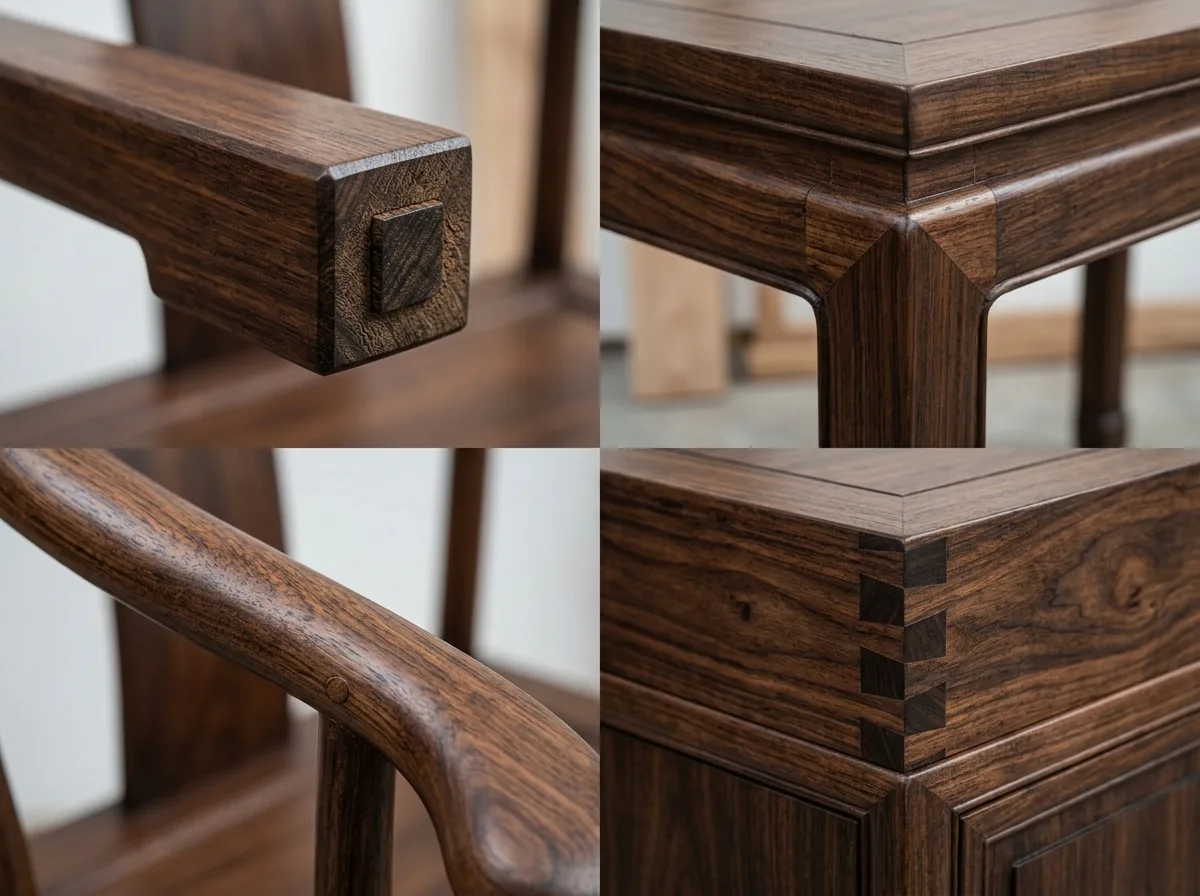
Ming-Style Joinery: Wedges, Collars, and Dovetails
Prompt
A close-up of furniture joints. Several types of mortise and tenon joints are visible on the surface: the end of a chair armrest has a square tenon protruding, revealing its cross-section, whose color is slightly different from the surrounding wood due to varying grain direction; at the junction of a table leg and tabletop, the joint line of a wedged tenon is visible; a small wedge pin passes through the joint on the curved armrest of a horseshoe-back armchair; the corner of a cabinet features an exposed dovetail joint, with interlocking segments. These joints are not filled or hidden but are smoothly polished and become part of the surface. The wood is dark hardwood, only waxed. There are no metal parts or nails. Avoid: filling and hiding the tenons, using metal screws and hardware for joining, adding carved decorations at the joints, or dyeing the wood a single color to conceal differences in cross-section.
Translated from Chinese by AI.
Show the original prompt
一組家具接合處的近景。畫面中可以看見數種榫卯在表面留下的痕跡:椅子的扶手末端有一個方形的榫頭穿出並露出斷面,顏色因為木紋方向不同而與周邊略異;桌腿與桌面的交接處可以看見夾頭榫的接縫線;圈椅的弧形扶手上有一枚小小的楔釘穿過接口;櫃體的轉角是明榫的燕尾接合,一格一格咬合。這些接合沒有被填補與隱藏,而是被打磨得平整並成為表面的一部分。木料是深色硬木,只上蠟。沒有任何金屬件與釘子。避免:把榫頭填平隱藏、使用金屬螺絲與五金接合、在接合處加雕花裝飾、把木料染成單一顏色掩蓋斷面的差異。