Text-to-Image
Interior Design
通用
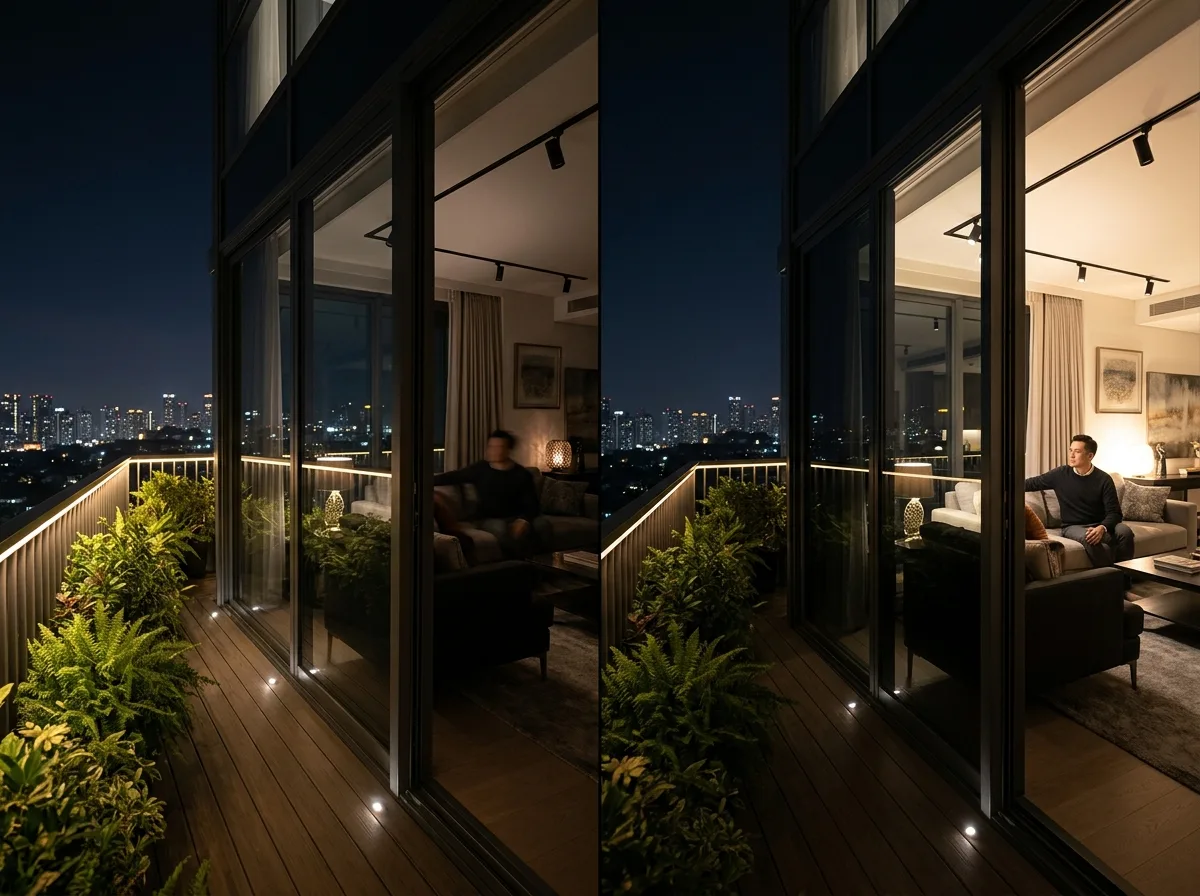
Balcony at night: Don't see yourself when looking out from indoors
Prompt
A night view from indoors looking out through large French windows onto a balcony. The balcony has low-level lighting: short ground lights, small spotlights under plants, and linear lights along the bottom edge of the railing, illuminating the outdoor floor, plants, and railing sufficiently for recognition. The indoor brightness is deliberately lowered to be similar to that of the balcony. Because the indoor and outdoor brightness are similar, the glass no longer acts as a mirror. People indoors can clearly see the balcony space and plants, allowing their gaze to extend outwards, making the interior feel larger. A corner of the image shows a comparison: when the main light is turned on indoors, the same glass immediately becomes a dark mirror, reflecting only the indoor ceiling and one's own reflection, and the balcony completely disappears. Avoid: Making both states look the same, illuminating the balcony brighter than the indoors, eliminating the glass reflection in the comparison, or using high-brightness floodlights on the balcony.
Translated from Chinese by AI.
Show the original prompt
從室內透過大片落地窗看向陽台的夜景。陽台上有低亮度的照明:地面的矮燈、植栽下方的小型投光、欄杆下緣的線性光,把戶外的地坪、植物與欄杆照到足以辨認。室內的亮度則被刻意壓低到與陽台相近。因為內外亮度接近,玻璃不再變成鏡子,人在室內看出去可以清楚看見陽台的空間與植物,視線得以延伸出去,室內感覺變大。畫面一角以對照呈現:室內開了主燈之後,同一片玻璃立刻變成黑鏡,只映出室內的天花與自己的倒影,陽台完全消失。避免:讓兩種狀態看起來一樣、把陽台照得比室內亮、消除對照中的玻璃反射、在陽台使用高亮度投光燈。