Text-to-Image
Landscape
通用
Tradition | Torii: The Minimal Boundary of Two Pillars and One Crossbeam
Prompt
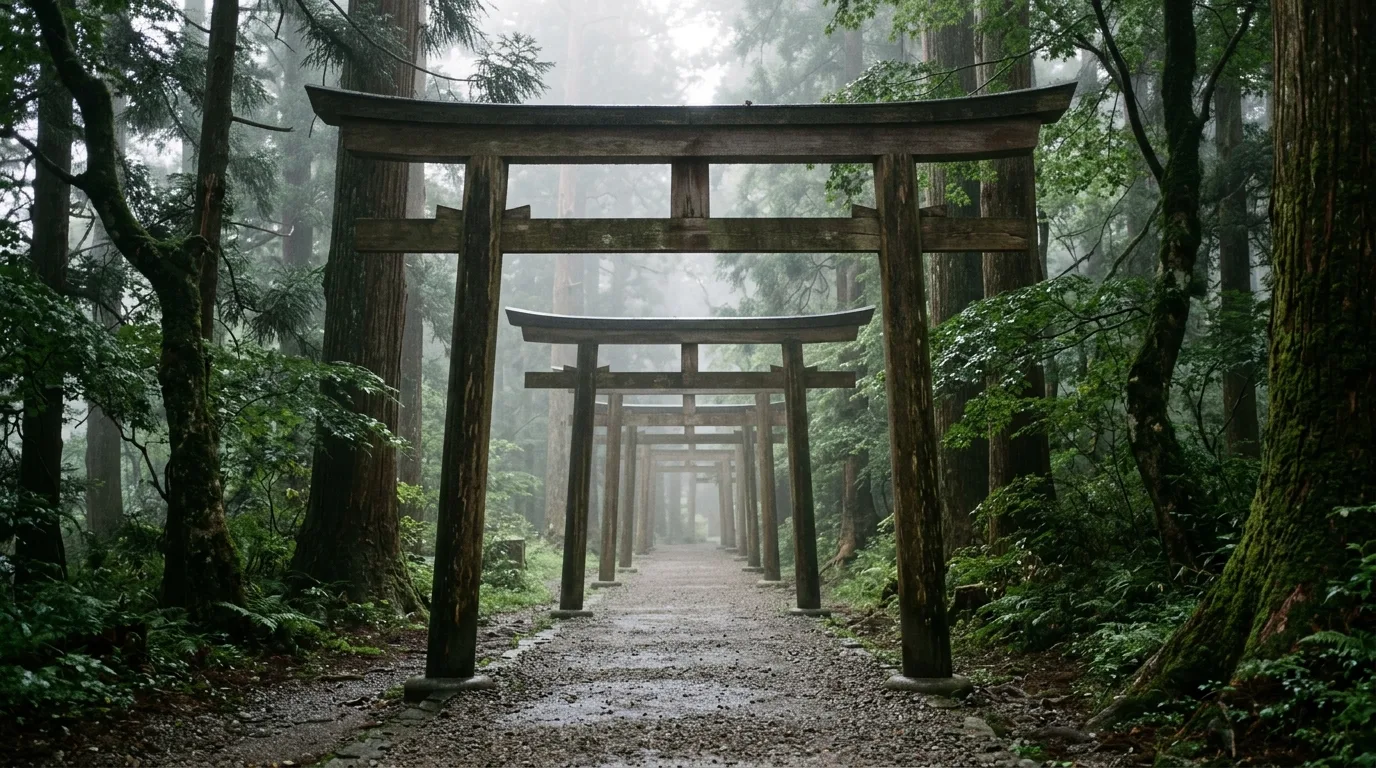
Define the boundary between the sacred and the secular with the fewest components: two posts, one kasagi (lintel), and one nuki (tie-beam), that's all. There are no doors, no walls, nothing that can be closed; passing through it is entirely voluntary, the boundary exists only in perception. The posts are slightly inclined inward to increase stability and visual focus. The ends of the kasagi are slightly upturned or straight, depending on the style. Materials are natural wood, vermilion lacquered wood, or stone. It is placed on a sando (approach path), with a gravel path in front and old trees on both sides. When multiple torii are continuously arranged, they form a tunnel-like passage in perspective. Photograph along the depth of the sando in the early morning mist. Avoid: adding doors or walls, vertical posts, imbalanced proportions, cluttered surroundings.
Translated from Chinese by AI.
Show the original prompt
以最少的構件界定神聖與世俗的邊界:兩根柱、一道笠木、一道貫,如此而已。沒有門扇、沒有牆、沒有可以關閉的東西,穿越它完全是自願的,界線只存在於認知之中。柱身微微向內傾斜以增加穩定與視覺的收束,笠木的兩端略微上翹或平直,依流派而異。材質為原木、朱漆木或石。設置在參道上,前方為砂石路徑,兩側為老樹。連續設置多座時,在透視中形成一條隧道般的通道。清晨薄霧中沿參道縱深拍攝。避免:加設門扇或圍牆、柱身垂直、比例失衡、周圍環境雜亂。