Text-to-Image
Interior Design
通用
Inserting New Elements into Historic Sites: Old and New Do Not Touch
Prompt
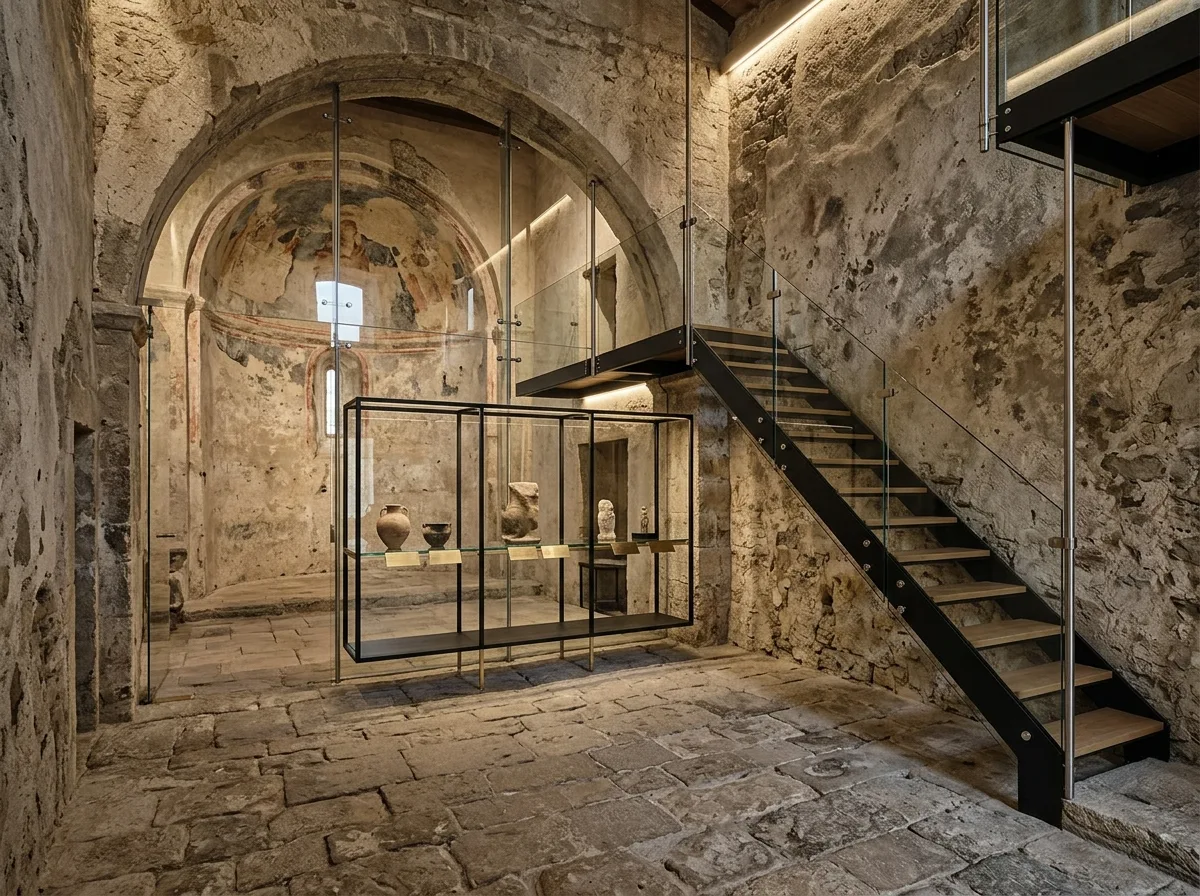
An interior where modern elements are inserted into a historic building. The original parts are completely preserved: mottled stone walls, faded fresco remnants, rough old flooring, arched openings, all left unadorned. The newly added elements are entirely contemporary—a display platform made of thin steel frames, a suspended steel plate staircase, a glass partition—they maintain distance from the old structure with extremely thin supports and minimal contact points, leaving visible gaps in between, making it clear which parts are new and which are old. The materials for the new elements are steel, glass, and brass, with precise, flat surfaces, contrasting with the roughness of the old stone. Lighting is hidden accent lighting. Avoid: allowing new and old materials to directly adhere, touching up existing mottling and damage, using new materials that imitate antique styles, making new elements heavy and overpowering the old building.
Translated from Chinese by AI.
Show the original prompt
一個在歷史建築中置入現代元素的室內。原有的部分完整保留:斑駁的石牆、褪色的壁畫殘跡、粗糙的舊地坪、拱形的開口,全部不做修飾。新加入的元素則是完全當代的——一組細鋼架構成的展示平台、一片懸空的鋼板樓梯、一道玻璃的隔屏——它們以極細的支撐與舊結構保持距離,接觸點極少,中間留有可見的縫隙,讓人清楚看出哪些是新的、哪些是舊的。新元素的材料是鋼、玻璃與黃銅,表面精確平整,與舊石材的粗糙形成對比。照明是隱藏的重點光。避免:讓新舊材料直接貼合、修飾舊有的斑駁與破損、使用仿古的新材料、把新元素做得厚重壓過舊建築。