Text-to-Image
Architecture
通用
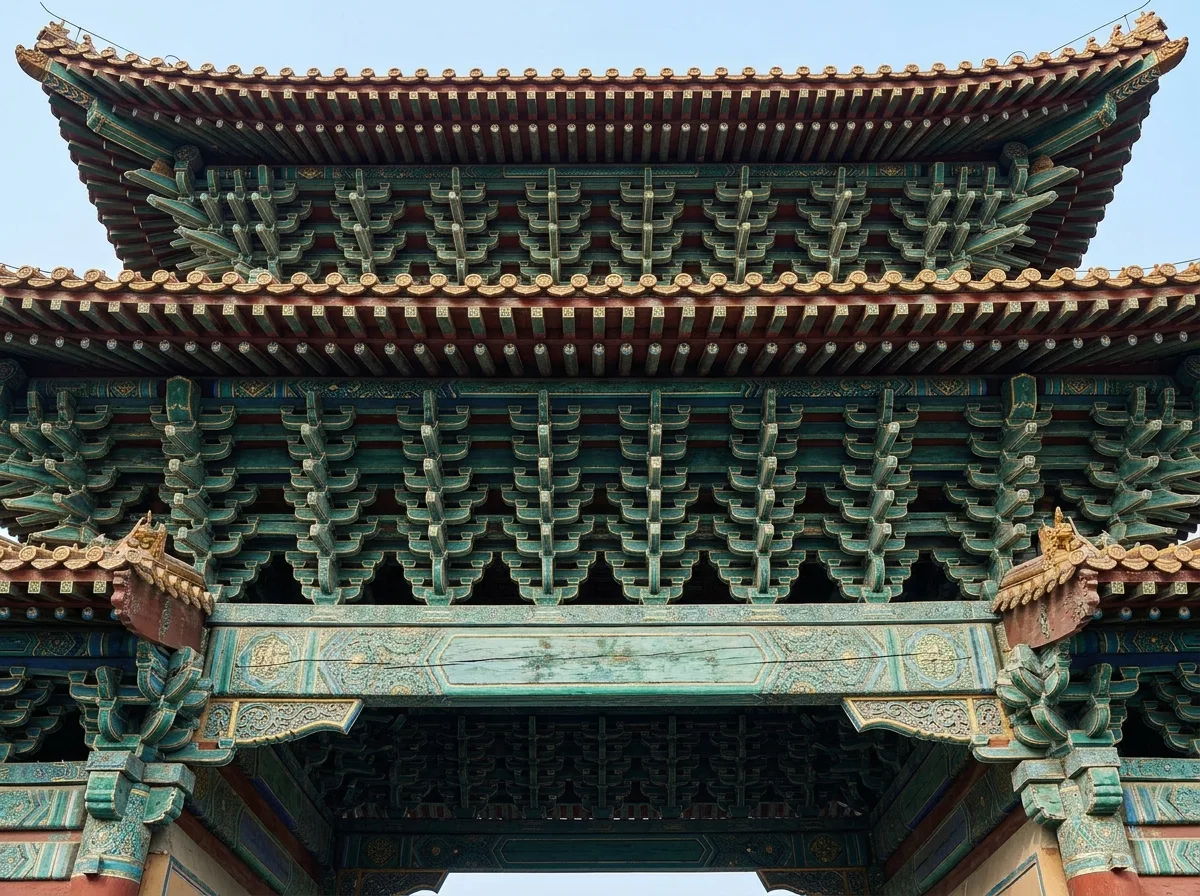
Dou Gong Layer: A Dense Row of Brackets
Prompt
An upward-looking detail of the entire layer of 'dougong' (bracket sets) above the paifang's lintel and below the eaves. The 'dougong' are arranged along the entire facade at extremely close intervals, with the distance between each set being only about the width of one 'dougong'. Each set consists of square 'dou' (blocks) and bow-shaped 'gong' (arms) interweaving in layers, projecting outwards three to four times, supporting the deep, overhanging eaves above. Due to their dense arrangement, the entire 'dougong' layer visually forms a thick horizontal band, full of intricate convexities, concavities, and shadows, making it the most complex part of the entire paifang. The 'dougong' feature green painted decoration and gold lines. When viewed from below, one can see the three-dimensional relationship of layers stacking outwards and upwards. Avoid: widening the spacing of the 'dougong' making them sparse, depicting the 'dougong' as flat decorative panels, omitting the projecting layers, using a flat frontal view that does not show the three-dimensional relationship.
Translated from Chinese by AI.
Show the original prompt
牌樓額枋之上、屋簷之下那一整層斗栱的仰視細部。斗栱以極密的間距沿著整個立面排列,朵與朵之間的距離僅約一個斗栱的寬度;每一朵由方形的斗與弓形的栱層層交錯出挑,共出三到四跳,把上方深遠的屋簷托住。因為排列密集,整條斗栱層在視覺上形成一道濃密的水平帶,充滿細碎的凹凸與陰影,是整座牌樓最複雜的部位。斗栱上有青綠色的彩畫與金線。從下往上看時,可以看見一層層向外向上疊出的立體關係。避免:把斗栱的間距拉大變得稀疏、把斗栱畫成平面的裝飾板、省略出跳的層次、使用正面平視看不出立體關係。