Text-to-Image
Landscape
通用
Time as material: Planting first, then waiting
Prompt
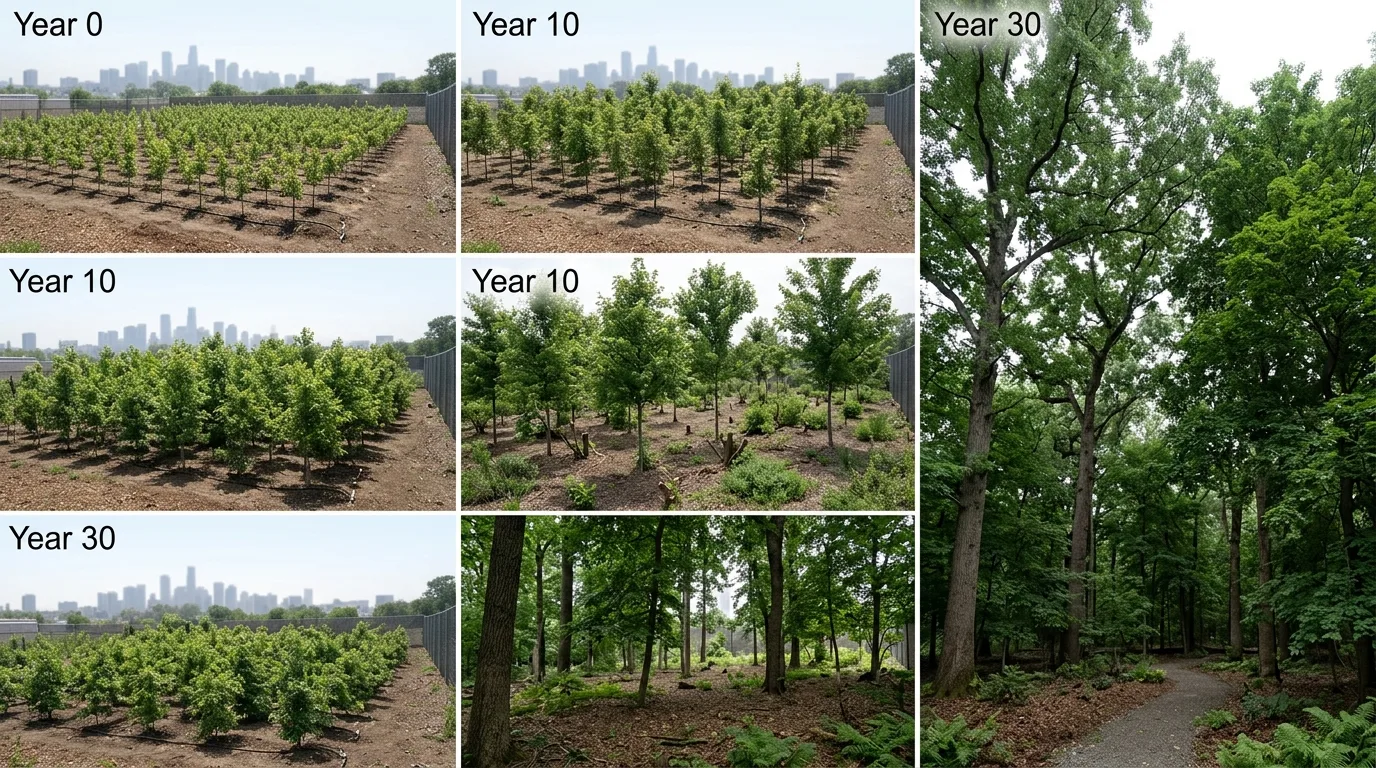
An urban forest designed with temporal succession as a method. The image presents three juxtaposed stages of the same site: the first stage shows densely planted small saplings, arranged in a regular grid with only 1.5 meters spacing, looking more like a nursery than a park; the second stage is ten years later, trees have grown taller and begun to compete, the designers have thinned out half of them according to plan, leaving better-formed trees; the third stage is thirty years later, only one-third of the trees remain, but each is a mature large tree, their canopies overlapping to form a true forest, with a natural leaf litter layer beneath. Thus, the object of design is this process, not the finished picture. Avoid: only presenting the final mature state, depicting the three stages as different locations, having the planting start with the final density, adding too many hard-paved facilities.
Translated from Chinese by AI.
Show the original prompt
一個以時間演替為設計方法的都市林。畫面呈現同一塊基地的三個階段並置:第一階段是密集種植的小苗,以規則的網格排列,間距僅一米五,看起來像苗圃而不是公園;第二階段是十年後,樹已經長高並開始競爭,設計者依計畫疏伐掉一半,留下的樹形態更好;第三階段是三十年後,只剩下三分之一的樹,但每一株都是成熟的大樹,樹冠交疊形成真正的林子,林下有自然的落葉層。因此設計的對象是這個過程而不是完成的畫面。避免:只呈現最終的成熟狀態、把三個階段畫成不同的地點、讓種植從一開始就是最終密度、加入過多的硬鋪面設施。