Text-to-Image
Landscape
通用
Boundary: Where Driving Stops
Prompt
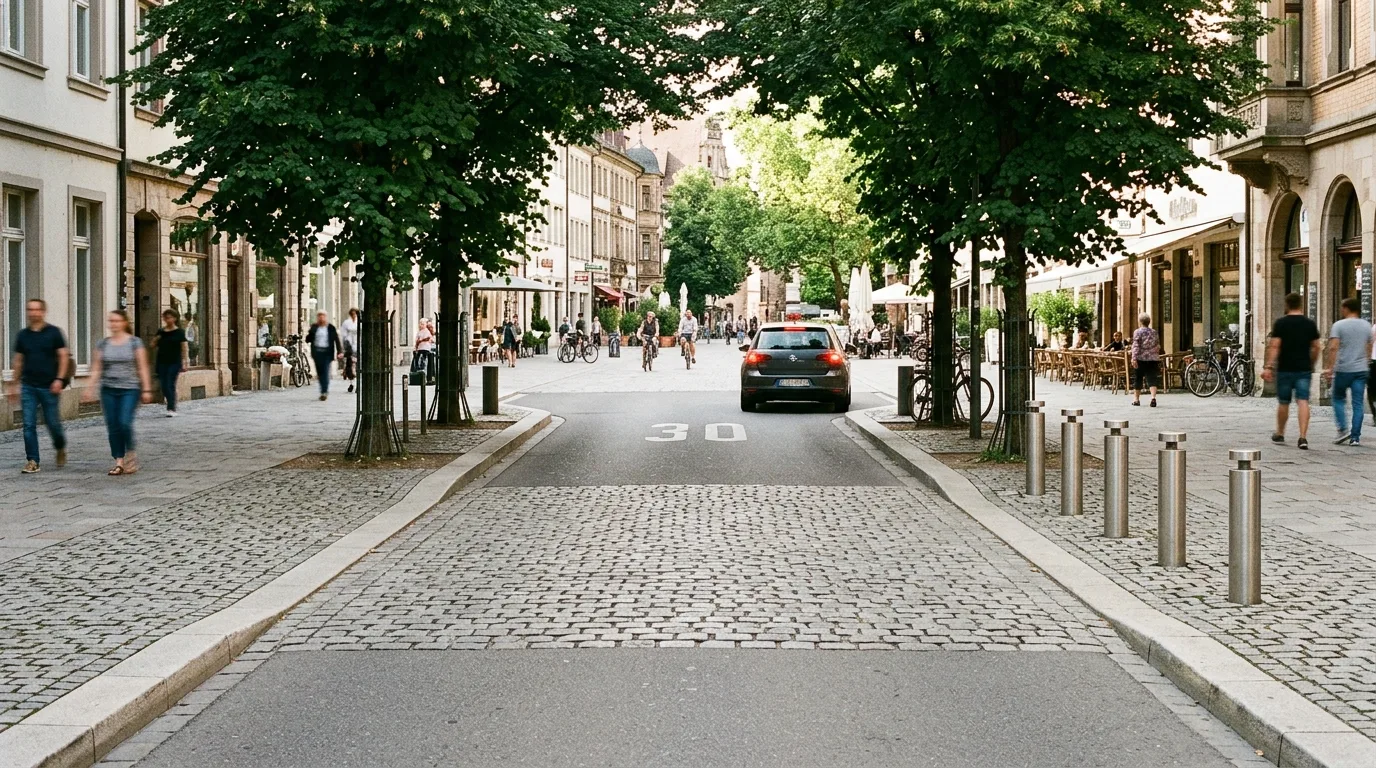
The boundary between a pedestrian zone and a general road. This transition is not achieved by a single no-entry sign, but by a whole set of spatial signals working simultaneously: the ground pavement changes from asphalt to small-sized stone or brick at this point, with a distinct difference in color and texture; the road width narrows here; the curbs on both sides are pushed outwards to form a bottleneck; the ground is slightly raised by three centimeters to create a gentle transition; a group of street trees becomes denser here, forming a gate-like feeling; retractable bollards are arranged at the narrowest point. Therefore, drivers will naturally slow down when approaching and realize that the nature of the area ahead has changed. Avoid: only using signs and markings to delineate the boundary, keeping the road width unchanged at the junction, eliminating changes in pavement material, making the transition a steep height difference.
Translated from Chinese by AI.
Show the original prompt
一個徒步區與一般道路的交界處。這個轉換不是靠一塊禁行標誌,而是靠一整套空間訊號同時作用:地面的鋪面在此處從柏油變成小尺寸的石材或磚,顏色與質感明顯不同;道路的寬度在此處縮窄;兩側的路緣被外推形成一個瓶頸;地面略微抬升三公分形成一個平緩的過渡;上方有一組行道樹在此處加密形成門的感覺;升降柱排列在最窄處。因此駕駛在接近時會自然減速並意識到前方性質改變。避免:只用標誌與標線標示邊界、讓道路寬度在交界處不變、消除鋪面材質的變化、把過渡做成陡峭的高差。