Text-to-Image
Interior Design
通用
Diffuser: The Back Wall Can't Just Be Absorptive
Prompt
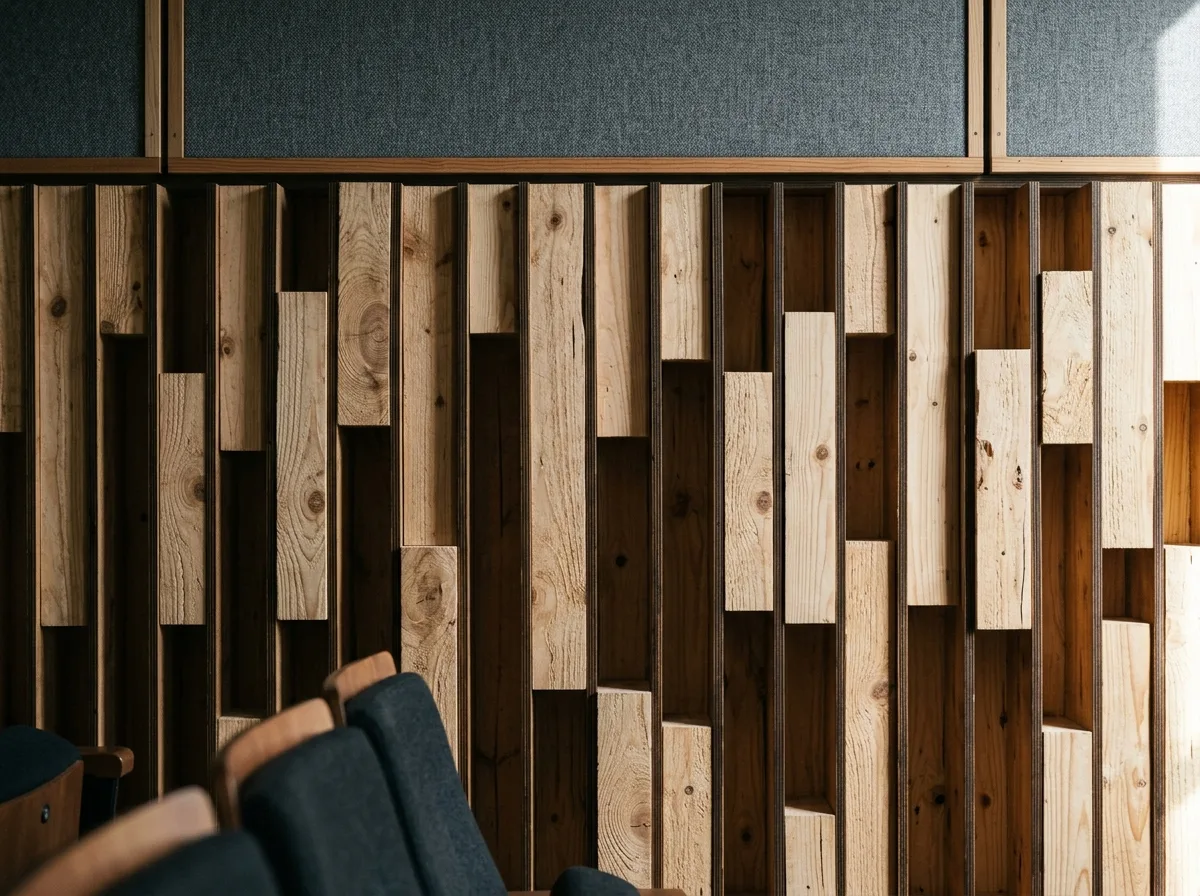
Close-up of the audience area's back wall: the entire wall is a quadratic residue diffuser composed of wooden strips of varying depths, with each cell's depth ranging from 30mm to 200mm, arranged in a mathematical sequence. Thin partitions separate the cells, forming an undulating, irregular three-dimensional surface. The wood is unpainted pine, showing its growth rings. The purpose of this wall is not to absorb sound, but to scatter reflections in various directions, preventing the back rows from hearing a single strong reflection from the back wall. The upper half of the wall is treated with sound absorption. Side lighting creates strong contrasts of light and shadow on the deep and shallow cells. Avoid: the back wall being a flat sound-absorbing panel, cells having uniform depth, the surface being painted or fabric-covered, the entire wall being treated with the same method.
Translated from Chinese by AI.
Show the original prompt
觀眾區後牆的近景:整面牆是由深度不一的木條組成的二次餘數擴散體,每一格的深度從 30mm 到 200mm 不等,依數學序列排列,格與格之間以薄隔板分開,形成一片起伏不規則的立體表面。木材是未上漆的松木,可以看見年輪。這道牆的作用不是吸掉聲音,而是把反射打散成各個方向,讓後排不會聽到來自後牆的單一強反射。牆的上半段另做吸音處理。側光讓深淺的格子呈現強烈的明暗。避免:後牆做成平整的吸音板、格子深度一致、表面上漆或包布、整面牆都做同一種處理。