Text-to-Image
Landscape
通用
Market Intervention: How to Arrange Stalls
Prompt
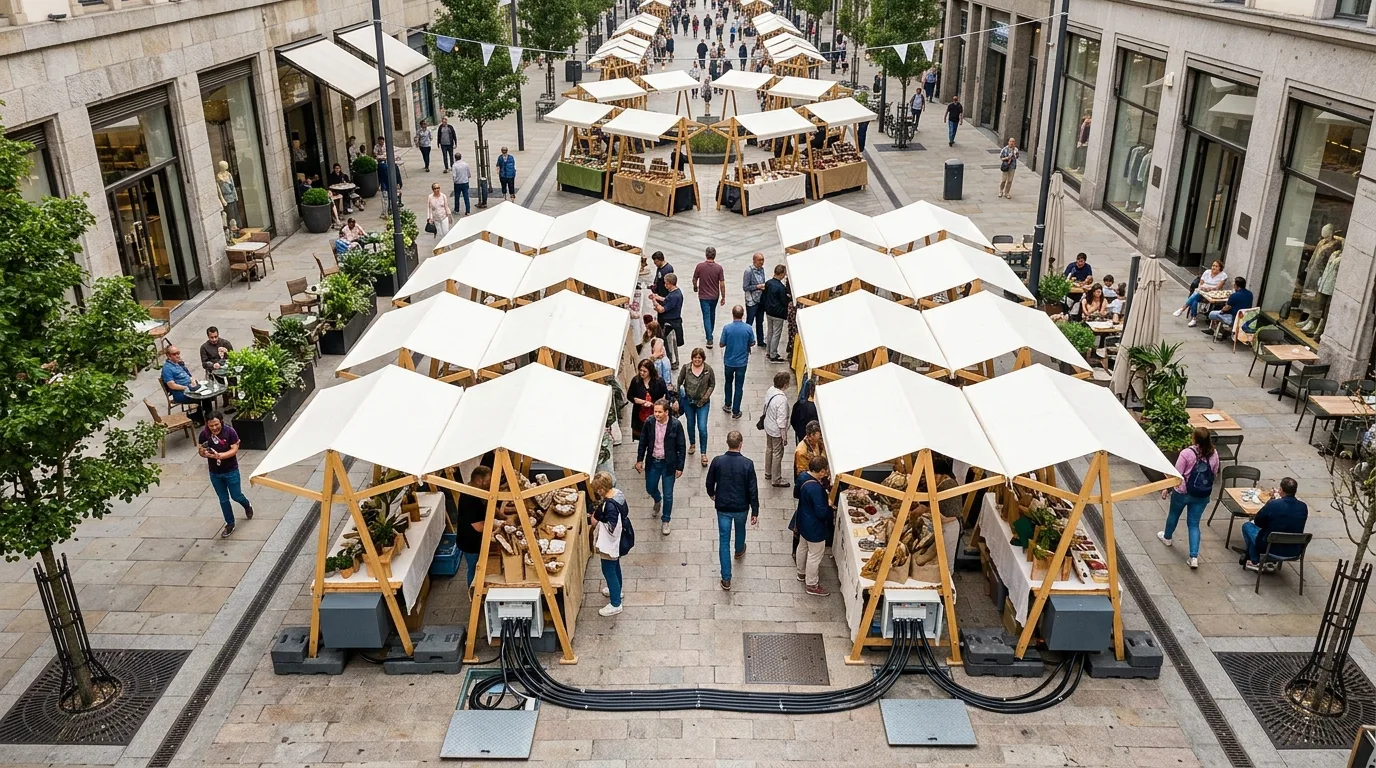
A market event on a pedestrian street. Stalls are arranged in two ways: first, in two rows along the central activity zone, leaving a middle passage, suitable for high foot traffic; second, clustered in block shapes at wider nodes. The stalls are uniform white or wooden tents, modular in size, with weighted bases instead of being driven into the ground. The pre-reserved ground sockets are in use—power cables are pulled from the cover plates and connected to each stall. Outdoor seating from adjacent shops coexists with market stalls, with entrances not blocked. After the market, everything can be removed, and the street returns to its original state. The image shows the operational state. Avoid: stalls blocking shop entrances and windows, using fixed structures that need to be driven into the ground, power cables scattered on the thoroughfare, or varied and messy stall styles.
Translated from Chinese by AI.
Show the original prompt
一條徒步街道上舉辦市集的狀態。攤位以兩種方式配置:一是沿著中央活動帶排成兩列並留出中間的通道,適合人流大的時候;二是在較寬的節點處圍成塊狀。攤位是統一的白色或木色帳篷,尺寸模組化,底部有配重而不是打入地面。地面上原本預留的插孔正在使用——電源線從蓋板下拉出接到各攤。兩側店家的外擺與市集攤位並存,並沒有被擋住入口。市集結束後所有東西都可以撤走,街道恢復原狀。畫面呈現營運中的狀態。避免:讓攤位擋住店家的入口與櫥窗、使用需要打入地面的固定結構、讓電線散落在通行帶上、把攤位的樣式做得雜亂不一。