Text-to-Image
Architecture
通用
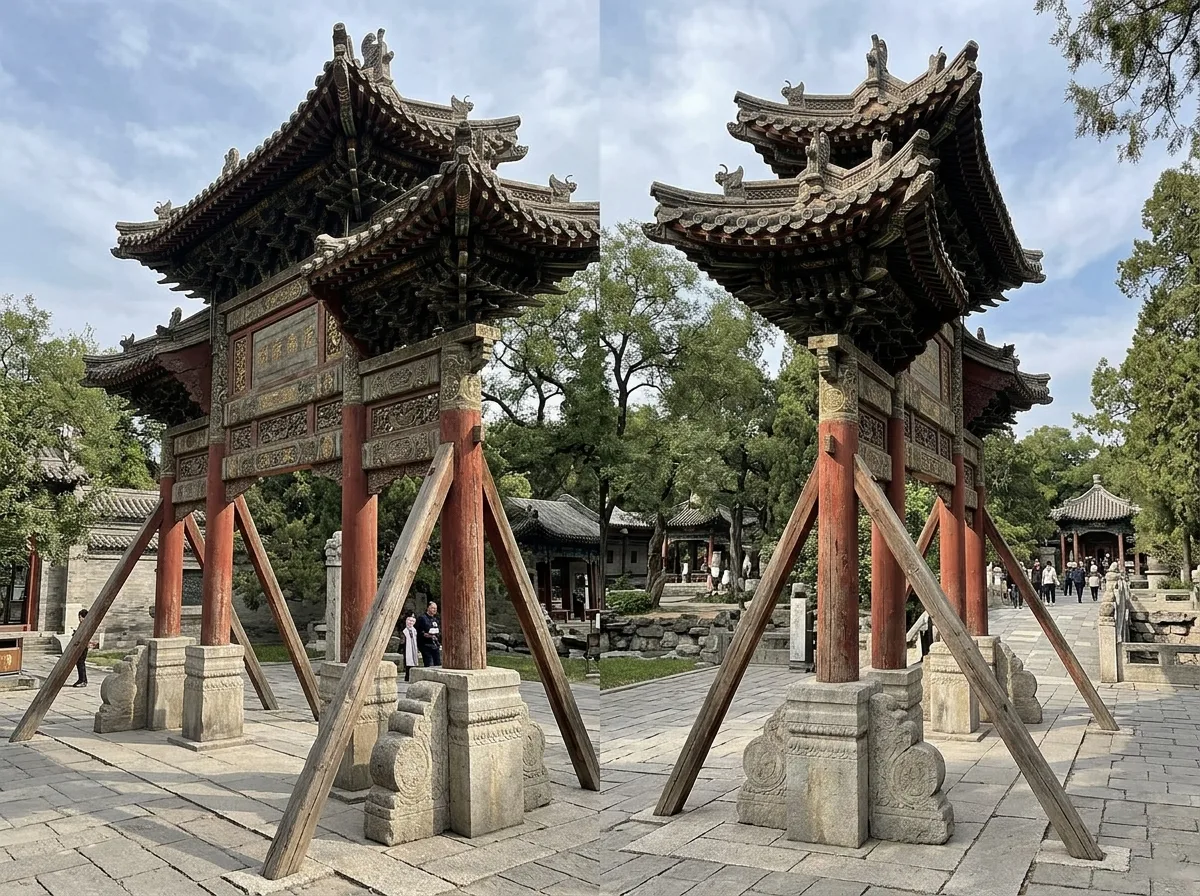
Oblique side view: Revealing its thinness
Prompt
Viewing the paifang from a side-front angle of approximately thirty degrees. This angle reveals a fact not apparent from the front: the entire structure is extremely thin in the depth direction, only the cross-section of the columns plus the thickness of the e-fang (architrave), about one meter; the stacked roof structures above are similarly thin. Thus, it is not a building but a vertical facade. At the same time, one can see the diagonal bracing columns (qiangzhu) at the front and back, the thickness of the夹杆石 (jiagan stone), and the staggered relationship of the side profiles of each roof structure. Light comes from the side, so the front is in shadow while the side is illuminated, clearly defining the boundary of the thickness. The space behind the paifang can be seen in the background. Avoid: using a front-on eye-level view that doesn't show thickness, depicting the depth as if it were a building, eliminating the qiangzhu and side structure, allowing light to eliminate the light-dark difference between the front and side.
Translated from Chinese by AI.
Show the original prompt
從側前方約三十度角觀看牌樓。這個角度揭露了正面看不出來的事實:整座構造在進深方向極薄,只有柱子的斷面加上額枋的厚度,大約一公尺多;上方層疊的樓頂也是同樣的薄片。因此它不是一棟建築而是一片豎起來的立面。同時可以看見前後的戧柱斜撐、夾杆石的厚度,以及各座樓頂的側面輪廓依次錯開的關係。光從側面來,正面在陰影中而側面被照亮,厚度的界線清楚。背景可以看見牌樓之後的空間。避免:使用正面平視看不出厚度、把進深畫得像一棟建築、消除戧柱與側面的結構、讓光線消除正側面的明暗差。