Text-to-Image
Landscape
通用
Inclusivity: It's Not Just About Adding an Accessible Ramp
Prompt
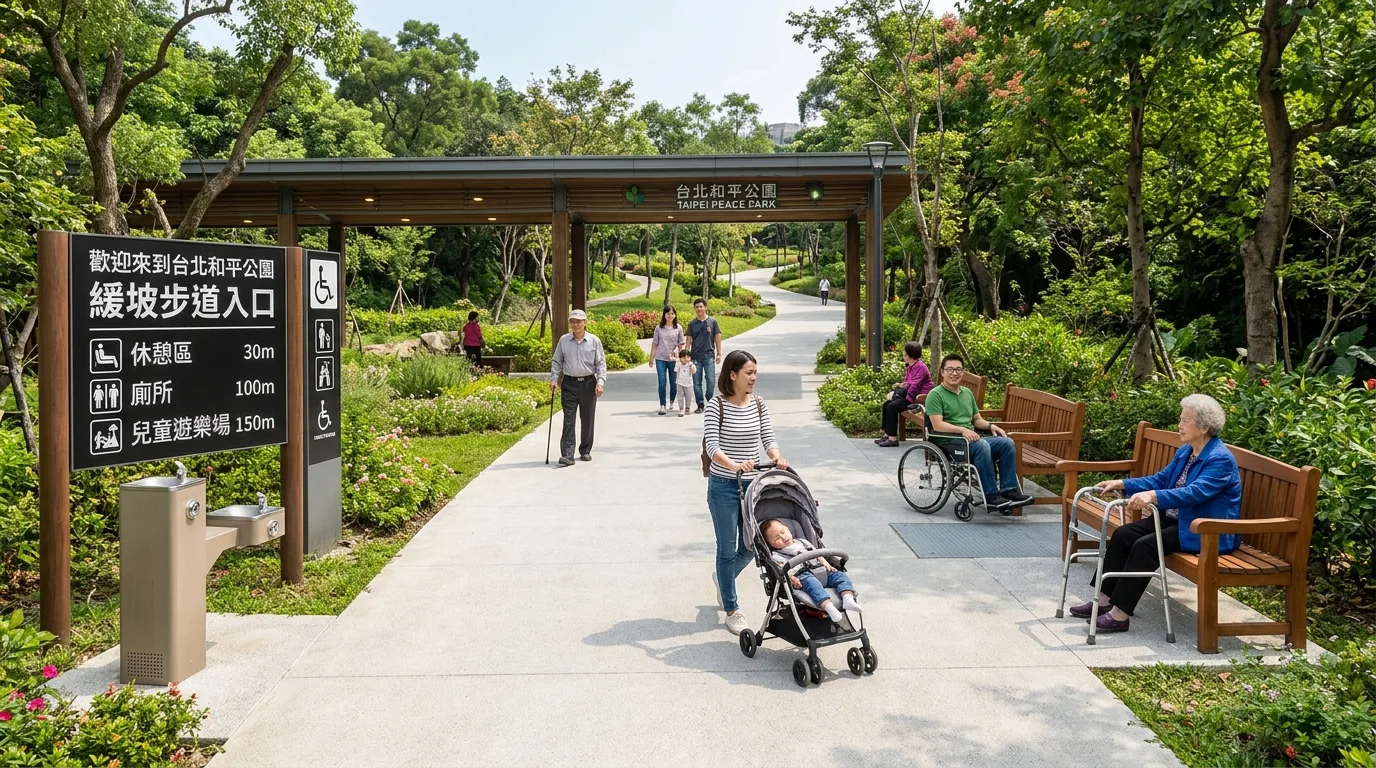
A park entrance and main pathway designed with all users in mind from the outset. Topographical elevation differences are not handled by adding separate accessible ramps, but by making the entire main path itself a gentle slope, so everyone uses the same route; there is no segregation of traffic with stairs and ramps running parallel. The paving is flat, non-slip, and continuous, with fine joints, so wheelchairs and strollers do not bump. Seating is available every thirty meters along the path for resting, some with armrests and backrests, with platform space next to them for wheelchair parking. Signage uses large fonts, high contrast, and appropriate height. Water fountains are at two different heights. The scene shows people using wheelchairs, pushing strollers, and elderly people using the path simultaneously. Avoid: creating separate circulation paths with stairs and ramps, using rough and uneven paving, making accessibility features into additional secondary paths, having only one type of seating.
Translated from Chinese by AI.
Show the original prompt
一個從整體設計就考慮所有使用者的公園入口與主動線。地形的高差不是以另設的無障礙坡道處理,而是把整條主要路徑本身就做成平緩的坡,所有人走同一條路;沒有階梯與坡道並行的分流。鋪面是平整、防滑且連續的,接縫細,輪椅與推車不會顛簸。沿線每隔三十公尺有可以停留的座位,其中一部分有扶手與靠背,旁邊留有輪椅停放的平台空間。標示的字體大、對比高、高度適中。飲水機有兩種高度。畫面中有使用輪椅的人、推嬰兒車的人與老人同時在使用。避免:設置階梯與坡道分流的動線、使用粗糙不平的鋪面、把無障礙設施做成附加的次要路徑、讓座位只有單一形式。