Text-to-Image
Interior Design
通用
Lattice Density: How much to block, how much to see
Prompt
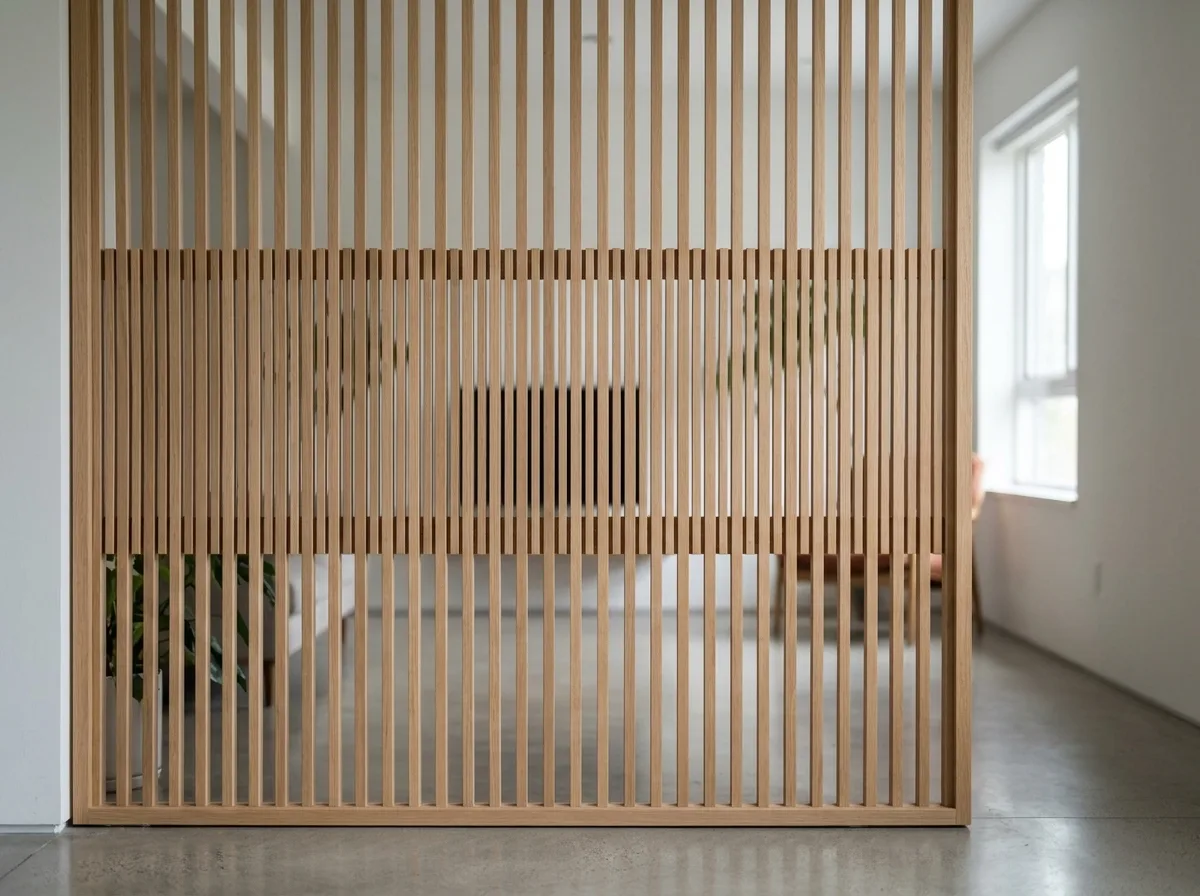
A wooden louver screen, with emphasis on varying spacing. The cross-section of the louvers is uniform, but the spacing is not equidistant—in sections where visual obstruction is desired, the spacing is dense, approximately equal to the louver width; in sections where transparency and light are desired, the spacing is widened to three times the louver width. Therefore, this screen has different transparency rates at different heights and positions, blocking the line of sight in dense areas and allowing vision through in sparse areas. When viewed obliquely from the side, the entire screen becomes almost opaque due to perspective; when viewed from the front, it is transparent. This characteristic allows the same screen to provide different levels of privacy at different circulation paths. Avoid: using completely equidistant spacing, making the louvers thick and robust, making the variations in density chaotic and illogical, using colored or carved louvers.
Translated from Chinese by AI.
Show the original prompt
一片木格柵隔屏,重點在間距的變化。櫺條的斷面統一,但間距不是等距的——在需要遮擋視線的段落間距密,約等於櫺條寬度;在希望通透與採光的段落間距拉大到三倍。因此這片屏在不同高度與位置有不同的通透率,而人的視線在密的地方被擋住、在疏的地方看得穿。從側面斜看時,因為透視的關係整片會變得幾乎不透明;正面看時則可以看穿。這個特性讓同一片屏在不同動線位置提供不同的隱私。避免:使用完全等距的間距、把櫺條做得粗壯、讓疏密的變化雜亂無邏輯、使用彩色與有雕刻的櫺條。