Text-to-Image
Interior Design
通用
Non-Parallel Walls: Eliminating Standing Waves
Prompt
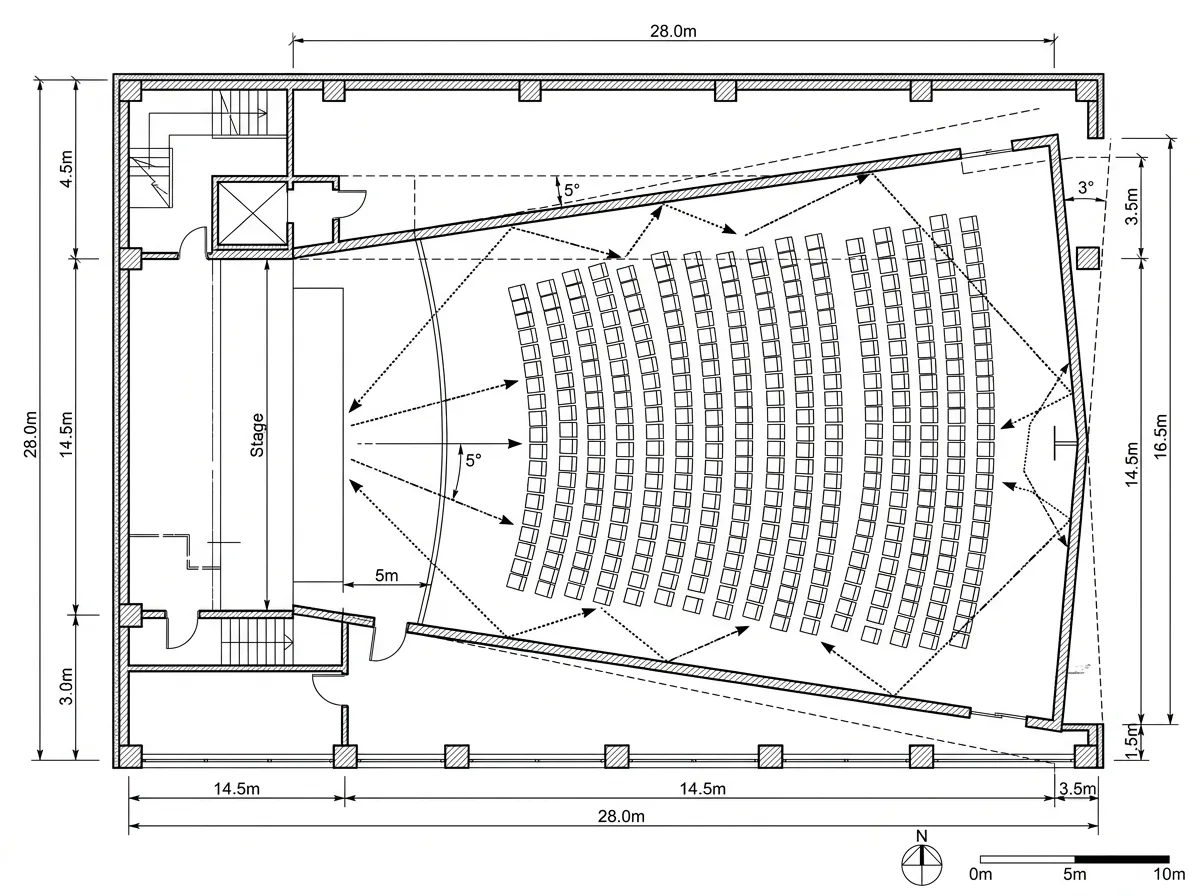
Present the acoustic geometry of a performance space in a floor plan: the two side walls are intentionally non-parallel, splaying outwards by approximately 5 degrees from the stage end to the audience end, and the rear wall is also not perpendicular to the stage surface, tilting slightly by 3 degrees. These angles are so small they are almost imperceptible to the naked eye, but sufficient to prevent standing waves and flutter echoes between parallel surfaces. The floor plan should indicate the position of the walls if they were parallel with dashed lines for comparison, and use arrows to illustrate the difference in sound reflection paths. The drawing is a black and white line drawing, with dimensions and angles annotated. Architectural drafting style. Avoid: drawing parallel walls, making angles large enough to cause obvious distortion, adding perspective or color rendering, omitting the indication of reflection paths.
Translated from Chinese by AI.
Show the original prompt
以平面圖的方式呈現一個表演空間的聲學幾何:兩道側牆刻意不平行,由舞台端向觀眾端張開約 5 度,後牆也與舞台面不垂直,略微傾斜 3 度。這些角度小到肉眼幾乎看不出來,但足以避免平行面之間產生駐波與顫動回聲。平面圖上以虛線標示若牆面平行時的位置作為對照,並以箭頭示意聲音反射路徑的差異。圖面是黑白線稿,標註尺寸與角度。建築製圖風格。避免:牆面畫成平行、角度做大到明顯變形、加入透視或彩色渲染、省略反射路徑的標示。