Text-to-Image
Landscape
通用
Mitsuru Senda | Circular Loop Structure: Letting Children Run in a Loop
Prompt
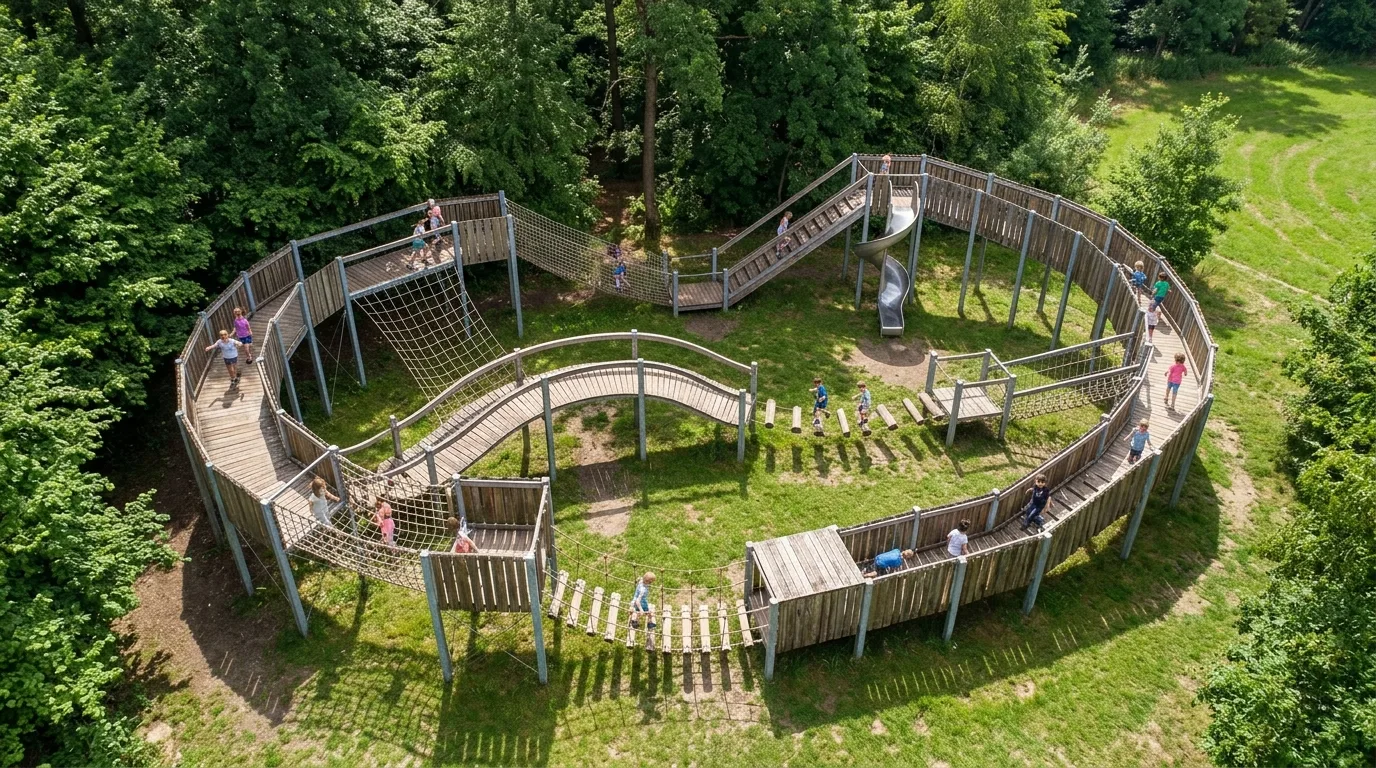
The core of the playground is not any single play equipment, but a circular path that allows continuous running: the path has elevation changes, holes to crawl through, gaps to jump over, dizzying rotation points, and recesses for brief stops. After completing one loop, one can immediately run another, without queuing or interruption. The path itself is composed of platforms, ramps, nets, and tunnels, made of wood, steel, and rope nets. The design's evaluation standard is "will children spontaneously run loop after loop?" Surrounded by woods and grass. Shot from a high angle during the day, the circular path and its elevation changes are clear. Avoid: paths with dead ends or terminals, requiring queuing, gentle and unchallenging elevation changes, play equipment that is independent and not part of a loop.
Translated from Chinese by AI.
Show the original prompt
遊戲場的核心不是任何單一遊具,而是一條可以持續奔跑的環狀路徑:路徑上有高低差、有需要鑽過的洞、有必須跳躍的間隔、有暈眩感的旋轉點,也有可以短暫停下的凹處,跑完一圈可以立刻再跑一圈,不需要排隊也不會中斷。路徑本身由平台、坡道、網與隧道串成,材料為木、鋼與繩網。設計的檢驗標準是「孩子會不會自發地一圈又一圈跑下去」。周圍為樹林與草地。日間從高處俯視拍攝,環狀的路徑與其上的高低變化清楚。避免:路徑有死路或終點、必須排隊使用、高低差平緩無挑戰、遊具彼此獨立不成迴路。