Image Editing
Architecture
GPT Image
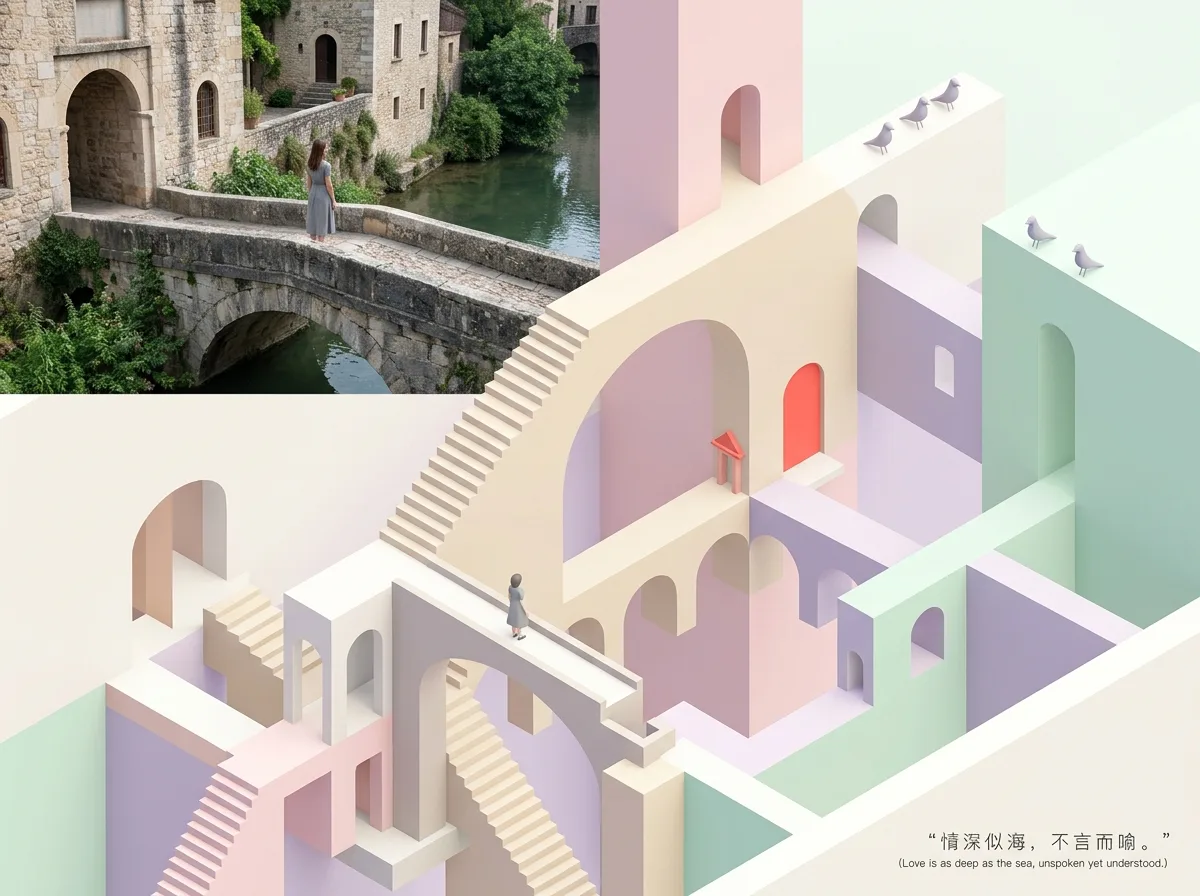
Monument Valley Geometry・Photo to Surreal Space Poster
Prompt
Extract the most recognizable subject, silhouette, posture, structural features, and narrative relationship from the photograph, then reinterpret them as a minimalist surreal 3D space with a Monument Valley-inspired visual language. Do not mechanically reproduce the original image. Translate its key characteristics into platforms, stairways, arches, passages, bridges, suspended structures, and impossible architecture, using height differences, pathways, connections, occlusion, isolation, and repetition to express the mood and story of the photograph. Use an orthographic isometric perspective. The geometry should feel clean, poetic, quiet, and surreal, while remaining clearly connected to the subject in the upper image.

Do not directly inherit the overall colors of the original photograph. Instead, use a distinctive Monument Valley-inspired pastel color system: cream white, pale sandstone, misty pink, coral, soft lavender, sky blue, aqua, mint green, and similar luminous tones. Each poster should automatically select 2-4 dominant colors, combining analogous hues with subtle warm-cool contrast. Add only one small high-purity accent color — such as coral red, vivid pink, turquoise, or soft yellow — on a doorway, turning point, figure, or key architectural detail. Emphasize large clean color fields, clear planar separation, and tonal variations within the same hue family. The overall palette should feel bright, airy, translucent, and dreamlike. Avoid muddy colors, yellowish casts, low-value palettes, large areas of brown or black, and generic muted Morandi palettes.

The 3D materials must be extremely clean, smooth, matte, and solid-colored, with soft even lighting and very subtle ambient shadows. The image should feel crisp, polished, and digitally pristine. No grain, film noise, paper texture, roughness, dust, distressed printing, speckled surfaces, heavy PBR materials, or glossy reflections.

Typography should appear only as small editorial annotations, never as a large headline. Based on the emotion, relationship, or story within the photo, generate one short poetic Chinese line or aphorism with subtle meaning and emotional resonance. Use thin, restrained, geometric typography that matches the Monument Valley-inspired visual system. Keep the text small, with generous letter spacing and ample negative space. Place it quietly along an edge, corner, architectural void, or empty area, allowing subtle alignment, overlap, or interaction with the geometry. A much smaller English translation may be added beneath it. Do not use years, dates, serial numbers, vol. labels, oversized typography, bold poster slogans, or dominant text.

The final result should create a dual narrative: the upper half represents the real world, while the lower half becomes its poetic spatial interpretation. Photography carries reality and memory; geometry carries emotion and metaphor; the small text leaves a quiet afterthought. The overall image should feel bright, clean, dreamy, restrained, intelligent, and unmistakably Monument Valley-inspired, while remaining adaptable to people, architecture, animals, still life, landscapes, and interior scenes.