Image Editing
People & Space
GPT Image
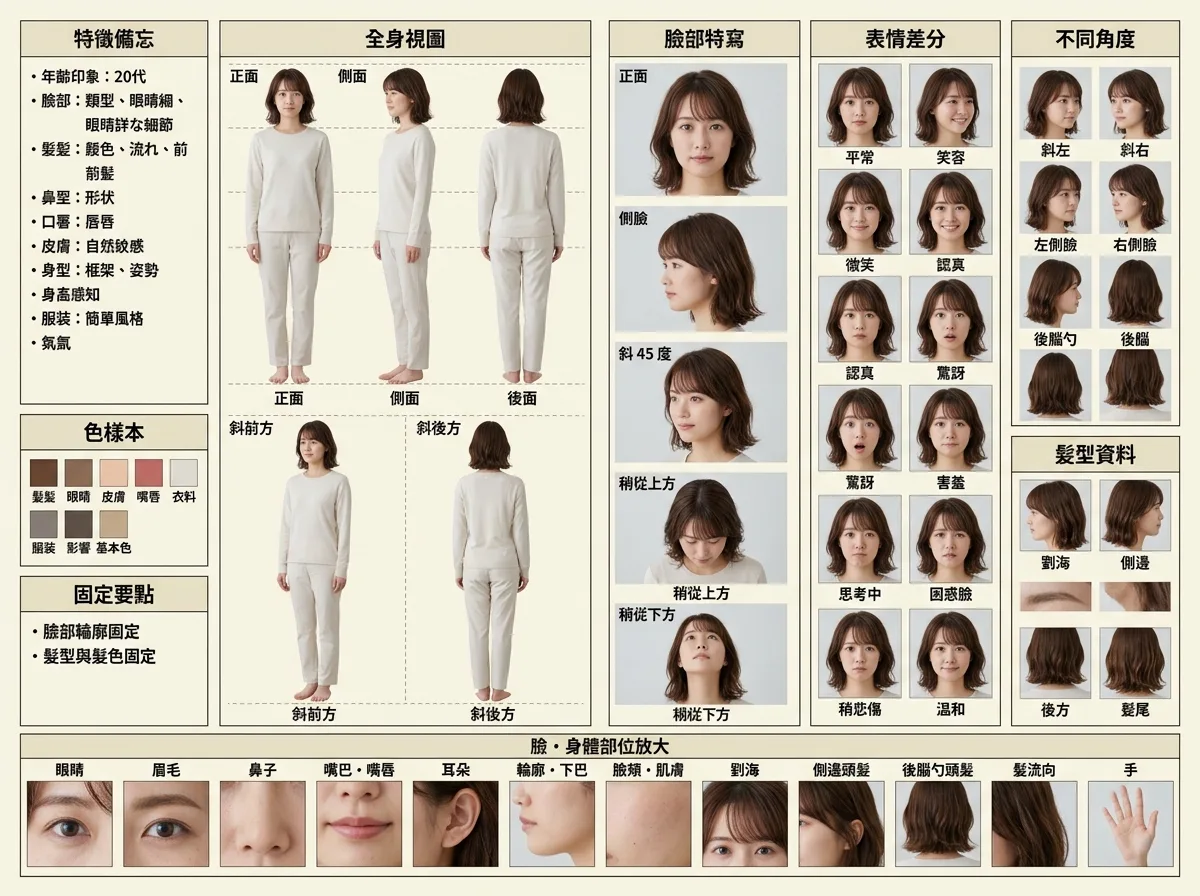
Fixed Character・High-Precision Reference Worksheet (Nine Panels)
Prompt
【Instruction Manual Worksheet Creation Tips】

Using the attached character image as the sole standard, create a "High-Precision Reference Worksheet" for AI image generation and character consistency. The purpose is not to create a profile, but to prepare visual data for stable reproduction of the same character in the future.

【Most Important: Character Consistency】
All panels must feature the same character. The following items must be faithfully maintained from the original image: face contour, face line, chin, eyes, eye area, gaze, eyebrows, nose bridge, nostrils, profile nose shape, lip shape, thickness, color, cheeks, skin tone, skin texture, natural undulations, hairstyle, bangs, side hair, back hair, hair flow, hair color, perceived age, body type, bone structure, shoulder width, limb length, overall body balance, clothing impression, overall atmosphere, and photo quality. Prohibited: transforming the character into someone else, facial reconstruction, excessive beautification, rejuvenation, body type alteration, hairstyle and hair color alteration.

【Art Style and Quality】
Completely maintain the original image's form of expression. Realistic → natural realistic photo; Illustration → maintain original lines, coloring, shading, and deformation style; 3D → maintain original 3D expression. Prohibited: unauthorized realistic rendering, anime-style rendering, or 3D rendering. For realistic images, present in a natural smartphone photo or data photo style, retaining natural pores, vellus hair, blood color, and skin undulations, avoiding a CG feel, plastic skin, or excessive retouching.

【Worksheet Format】
Horizontal 16:9 to 16:10, white to light beige background. Simple data layout using fine grids and frames for broad organization. Prohibited: magazine, resume, poster, or SNS post style.

【Panel Composition】
① Full-body view: front, side, back, diagonal front, diagonal back; natural standing pose, composition allowing confirmation of body type, bone structure, limbs, shoulder width, and clothing silhouette.
② Face close-up: front, profile, 45-degree angle, slightly from above, slightly from below; presented in a way that allows confirmation of facial three-dimensionality, contour, eyes, nose, mouth, chin, and hair drape.
③ Expression variations (maintaining the same character): normal, smile, smirk, serious, surprised, shy, thinking, confused, slightly sad, gentle.
④ Enlarged face/body parts: eyes, eyebrows, nose, mouth, lips, ears, contour, cheeks, skin, bangs, side hair, back hair, hair flow, hands; naturally depicted, without distortion or flaws.
⑤ Hairstyle data: bangs, sides, back, hair ends, bundle feel, hair color, light texture; bangs, part, side hair, and back hair unified across all panels.
⑥ Different angles: diagonal left, diagonal right, left profile, right profile, back of head, from above, from below; maintaining face, hairstyle, body type, and atmosphere even with changing angles.
⑦ Feature memo: brief bullet points on the left or bottom listing features to be consistently maintained, such as age impression, face, hair, eyes, eyebrows, nose, mouth, skin, body type, perceived height, clothing, atmosphere; limited to visually observable features, no fictional stories or profile settings.
⑧ Color palette: 5 to 7 colors, for hair, pupils, skin, lips, clothing, shadows, and overall base tone, each with a short Japanese label.
⑨ Consistency memo: fixed face contour, fixed eye area, fixed hairstyle and hair color, fixed skin texture, fixed body type and overall balance, unified clothing, highest priority on same character identity.

【Clothing】
If the clothing in the original image is clear, maintain it completely. Only when unclear or cropped, supplement with simple and clean white to light gray clothing. Prohibited: underwear, swimwear, excessive exposure, sexy clothing, flashy accessories. Use the same clothing across all panels.

【Labels】
Use only Japanese text within the image, with short, easy-to-read labels, not overlapping text on the face or important parts. Prohibited: garbled text, broken text, extremely small text. Examples: 「全身 正面」「全身 側面」「全身 後面」「臉部 正面」「側臉」「斜 45 度」「笑容」「驚訝」「眼睛」「眉毛」「鼻子」「嘴巴」「肌膚」「劉海」「側邊頭髮」「後腦勺頭髮」「手」「特徵備忘」「色樣本」「固定要點」.

【Layout】
Left side: feature memo, color palette, consistency points; Center: full-body view, face close-up presented in large size; Right side: expression variations, different angles, face parts; Bottom: details such as eyes, nose, mouth, hair, skin, hands. Align each panel and arrange them at easily comparable sizes. Despite the large amount of information, ensure white space to avoid clutter.

【Photography/Depiction】
Natural light or soft indoor light, presented at a brightness that makes facial features, hairstyle, and skin texture easy to understand, with a plain background, treated as objective data photos. Prohibited: cinematic lighting, strong blur, excessive makeup, glamorous poses, fashion magazine-style presentation.

【Exclusions】
Character transformation into someone else, face alteration, hairstyle and hair color alteration, body type alteration, age perception alteration, excessive beautification, rejuvenation, sexy expressions, exposure, flashy clothing, unnecessary small items, food, logos, watermarks, signatures, CG feel, plastic skin, garbled text, English labels, long profile texts, broken layouts, hand and finger flaws, distorted profiles, extra fingers, duplicate faces, unauthorized art style changes.

【Final Instruction】
Treat the character in the attached image as the sole correct answer, prioritizing character consistency above all else. Ensure face, hair, skin, body type, clothing, perceived age, and atmosphere are completely unified across all panels, creating a horizontal, clean, and objective instruction manual worksheet for future image generation to reproduce the character.
Translated from Chinese by AI.
Show the original prompt
【使用說明書工作表製作提示】

以附加的人物圖像為唯一標準,製作一張可用於 AI 圖像生成・角色固定的「高精度參考工作表」。目的不是製作個人檔案,而是為未來穩定再現同一人物而準備的視覺資料。

【最重要:人物的一致性】
全面板務必為同一人物。以下項目請從原圖像忠實維持:臉部輪廓・臉線・下巴、眼睛・眼周・視線・眉毛、鼻樑・鼻翼・側臉鼻形狀、嘴唇形狀・厚度・顏色、臉頰・膚色・膚質・自然的凹凸、髮型・劉海・側邊頭髮・後腦勺頭髮・髮流向・髮色、年齡感、體型・骨架・肩寬・手腳長度・全身平衡、服裝印象、整體氛圍・照片質感。禁止將人物變成他人、臉部重製、過度美化、年輕化、體型變更、髮型與髮色變更。

【畫風・質感】
完全維持原圖像的表現形式。寫實→自然的寫實照片;插圖→維持原來的線條・上色・陰影・變形風格;3D→維持原來的 3D 表現。禁止擅自寫實化・動漫化・3D 化。寫實的情況下,請以自然的智慧型手機照片或資料照片風格呈現,保留自然的毛孔・絨毛・血色・肌膚凹凸,避免 CG 感・塑膠肌・過度修圖。

【工作表形式】
橫長 16:9 至 16:10、白至淡米白色背景。使用細格線・方框進行大範圍整理的簡單資料版面配置。禁止雜誌・履歷表・海報・SNS 貼文風格。

【面板構成】
① 全身視圖:正面、側面、後面、斜前方、斜後方;自然站立姿勢,能確認體型・骨架・手腳・肩寬・服裝輪廓的構圖。
② 臉部特寫:正面、側臉、斜 45 度、稍從上方、稍從下方;以能確認臉部立體感、輪廓、眼鼻口、下巴、頭髮垂落方式的方式呈現。
③ 表情差分(維持同一人物):平常、笑容、微笑、認真、驚訝、害羞、思考中、困惑臉、稍悲傷、溫和。
④ 臉・身體部位放大:眼睛、眉毛、鼻子、嘴巴、嘴唇、耳朵、輪廓、臉頰、肌膚、劉海、側邊頭髮、後腦勺頭髮、髮流向、手;自然描繪,無扭曲・破綻。
⑤ 髮型資料:劉海、側邊、後方、髮尾、束感、髮色、受光質感;全面板統一劉海・分線・側邊頭髮・後腦勺頭髮。
⑥ 不同角度:斜左、斜右、左側臉、右側臉、後腦勺、從上方、從下方;即使角度改變,也維持臉部・髮型・體型・氛圍。
⑦ 特徵備忘:左側或下方以簡短項目符號列出年齡印象、臉部、頭髮、眼睛、眉毛、鼻子、嘴巴、肌膚、體型、身高感、服裝、氛圍等固定應維持的特徵;僅限目視可見的特徵,禁止虛構故事・個人檔案設定。
⑧ 色板:5 至 7 色,頭髮・瞳孔・肌膚・嘴唇・服裝・陰影・整體基調色,各色附上簡短日文標籤。
⑨ 一致性備忘:固定臉部輪廓、固定眼周、固定髮型與髮色、固定肌膚質感、固定體型與全身平衡、統一服裝、最優先同一人物性。

【服裝】
若原圖像的服裝明確,則完全維持。僅在不明・裁切的情況下,補充白色至淺灰色的簡單且乾淨服裝。禁止內衣、水著、過度暴露、性感服裝、華麗配件。全面板使用相同服裝。

【標籤】
圖像內的文字僅使用日文,使用簡短易讀的標籤,不疊加文字於臉部或重要部位,禁止文字亂碼、崩壞、極端小字。例:「全身 正面」「全身 側面」「全身 後面」「臉部 正面」「側臉」「斜 45 度」「笑容」「驚訝」「眼睛」「眉毛」「鼻子」「嘴巴」「肌膚」「劉海」「側邊頭髮」「後腦勺頭髮」「手」「特徵備忘」「色樣本」「固定要點」。

【版面配置】
左側:特徵備忘・色樣本・固定要點;中央:全身視圖・臉部特寫以大尺寸呈現;右側:表情差分・不同角度・臉部部位;下方:眼睛・鼻子・嘴巴・頭髮・肌膚・手等細節。將各面板對齊,以易比較的大小配置。資訊量雖多,也確保空白,避免雜亂。

【拍攝・描繪】
自然光或柔和室內光,以臉部・髮型・肌膚質感易懂的亮度呈現,無地背景,以客觀的資料照片方式處理。禁止電影風燈光、強烈模糊、過度化妝、華麗姿勢、時尚雜誌風演出。

【排除】
人物變成他人、臉部變更、髮型與髮色變更、體型變更、年齡感變更、過度美化、年輕化、性感表現、暴露、華麗服裝、不必要小物、食物、logo、水印、簽名、CG 感、塑膠肌、文字亂碼、英文標籤、長文個人檔案、崩壞版面、手與手指破綻、扭曲側臉、多餘手指、重複臉部、擅自畫風變更。

【最終指示】
以附加圖像的人物為唯一正確答案,最優先同一人物性。臉部・頭髮・肌膚・體型・服裝・年齡感・氛圍全面板完全統一,製作一張橫長乾淨且客觀的使用說明書工作表,以供未來圖像生成再現該人物。