Text-to-Image
Interior Design
通用
The Inside of a Drawer: How to Make the Invisible
Prompt
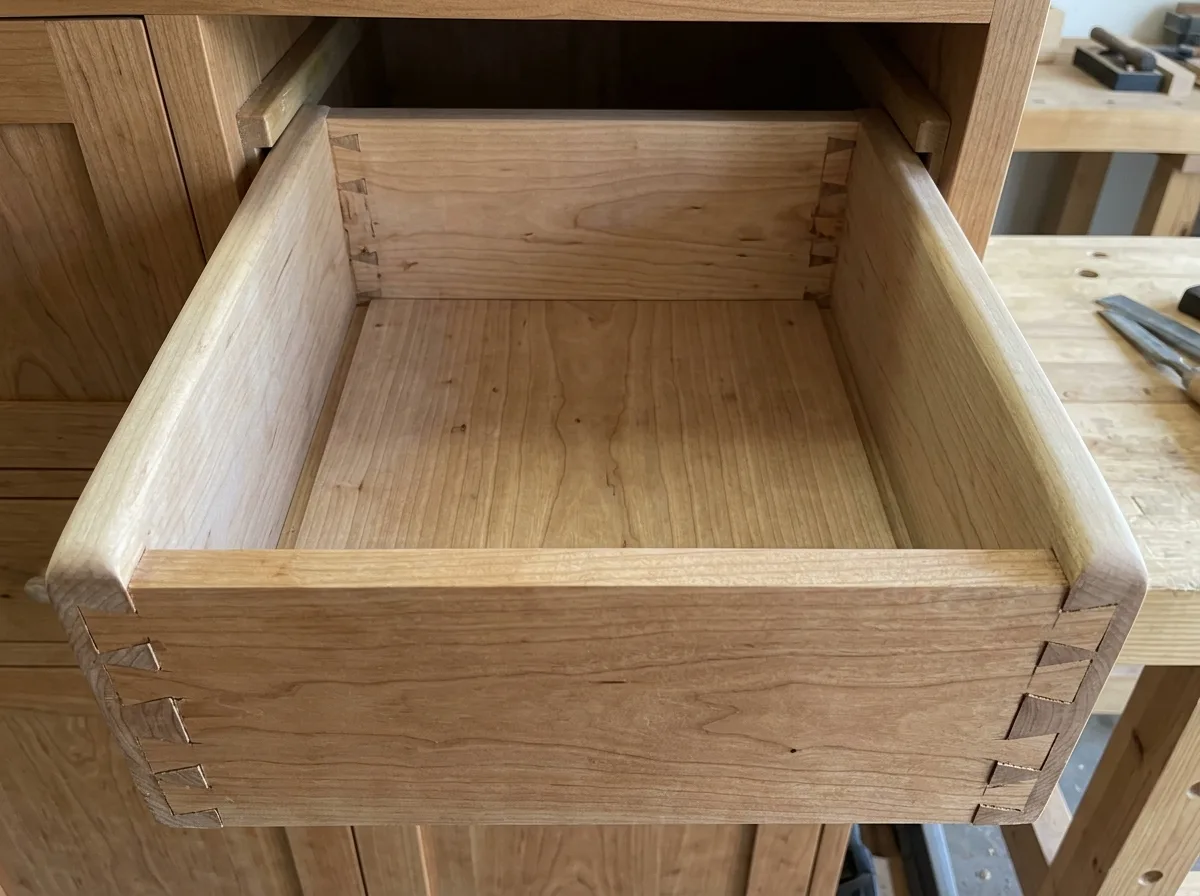
A close-up, top-down view of a fully extended drawer, focusing on structural details usually unnoticed by the user: the four corners feature handmade dovetail joints, with unevenly spaced pins hand-sawn and slightly angled at the ends, distinctly different from uniformly machine-cut joints. The drawer bottom is a thin solid wood panel fitted into grooves on all four sides, without nails, allowing for expansion and contraction with humidity. The upper edge of the side panels has a subtle rounded corner. The interior has no finish, retaining the natural color and scent of raw wood. Drawer sliding relies on wooden runners and wax. Soft overhead lighting. Avoid: uniformly machine-cut pins, bottom panel fixed with nails or glue, painted interior, metal runners.
Translated from Chinese by AI.
Show the original prompt
一個被完全拉開的抽屜的俯視近景,重點在使用者平常不會注意的構造:四個角落是手工鳩尾榫,榫齒的間距不等、由手工鋸出,尾端略帶斜度,與機器切的均勻榫明顯不同。抽屜底板是薄的實木板嵌在四邊的槽裡,沒有用釘子,可以隨濕度伸縮。側板的上緣做了一道細微的圓角。內部沒有任何塗裝,是原木的顏色與氣味。抽屜滑動靠木製的滑軌與蠟。柔和的頂光。避免:榫齒做成均勻的機器切、底板用釘或膠固定、內部上漆、使用金屬滑軌。