Text-to-Image
Architecture
通用
Looking up: Oppression from below
Prompt
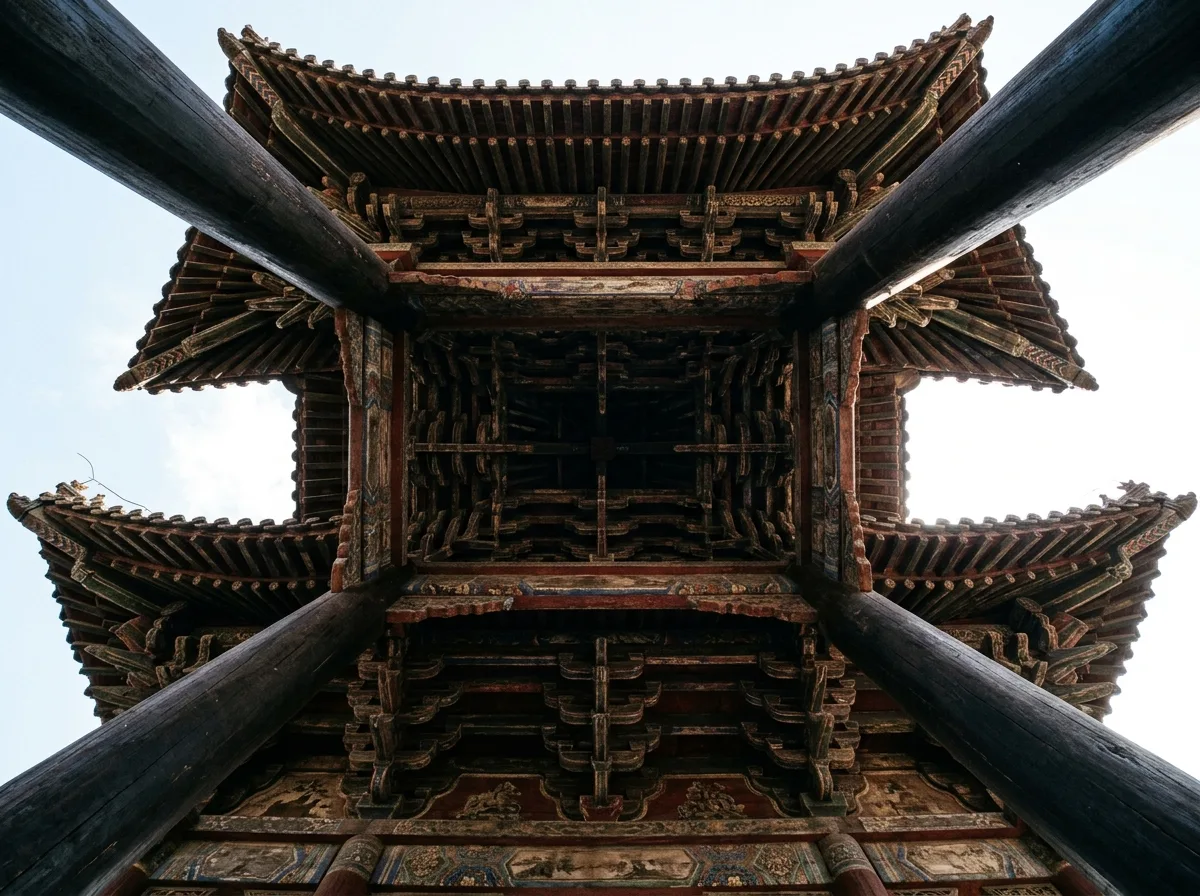
An upward-looking perspective from directly beneath a paifang. The camera is almost on the ground, lens pointing upwards, so the columns converge sharply towards the center from both sides of the frame. The e-fang (architrave) and dougong (bracket sets) layers unfold overhead, and the rafters of the eaves extend radially. The sky is visible only in small patches through the gaps in the structural components. This angle most clearly shows the three-dimensional relationship of the dougong layers projecting outwards—the depth of each outward and upward step, the details of the painted decoration, and the shadows between components are all visible. The strong convergence of vertical lines creates a distinct sense of height and oppression. Backlighting renders the components as semi-silhouettes, with only their edges highlighted. Avoid: using an eye-level perspective, eliminating the convergence of vertical lines, depicting components as flat without depth, using uniform frontal fill light.
Translated from Chinese by AI.
Show the original prompt
從牌樓正下方向上仰視的視角。相機幾乎貼著地面、鏡頭朝上,因此柱子從畫面的兩側急遽地向中心匯聚,額枋與斗栱層在頭頂上方展開,屋簷的椽子呈放射狀延伸,天空只從構件的縫隙中露出幾塊。這個角度把斗栱層層出挑的立體關係表現得最清楚——可以看見每一跳向外向上疊出的深度、彩畫的細節與構件之間的陰影。垂直線的強烈匯聚造成明顯的高聳感與壓迫感。逆光讓構件呈現為半剪影,只有邊緣被勾亮。避免:使用平視角度、消除垂直線的匯聚、把構件畫成平面看不出深度、使用均勻的正面補光。